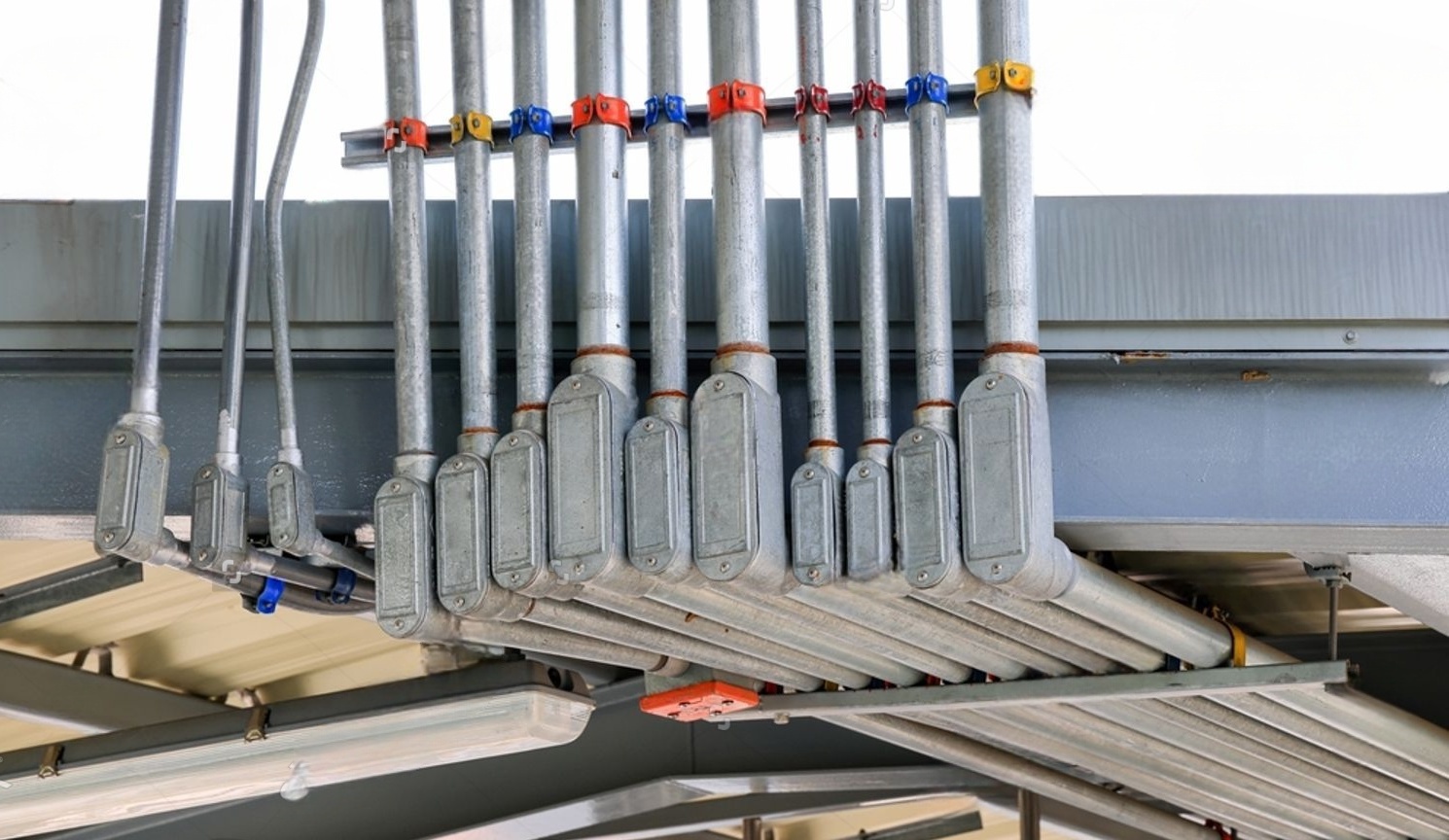
If you’ve ever wondered how electricians navigate wires around corners, through walls, or split circuits efficiently, the answer often lies in a small but mighty component: the conduit body. This essential electrical fitting plays a pivotal role in organizing, protecting, and directing wiring systems—making it a unsung hero of safe and functional electrical setups. Let’s dive into what conduit bodies are, their key functions, and the most common types used in electrical projects.
At its core, a conduit body is a connecting and redirecting fitting for electrical conduits—those protective tubes that house and shield wires from physical damage, moisture, and environmental hazards. Think of conduits as the "highways" for wires, and conduit bodies as the "interchanges" that let those highways change direction, merge, or split.
Conduit bodies act as joints that allow raceways (the pathways formed by conduits) to bend, turn, or branch without compromising the integrity of the wiring system. Each design features a removable cover, giving electricians easy access to pull, adjust, or maintain wires—no need to disconnect entire sections of conduit. A gasket between the cover and the body adds an extra layer of protection, sealing out moisture and debris to keep wires safe.
While some conduit bodies are straight (serving as access points rather than direction-changers), most are designed to redirect wiring at angles or create junctions. Their versatility makes them indispensable in both residential and commercial electrical work, from routing wires around wall corners to managing complex circuit splits in industrial settings.
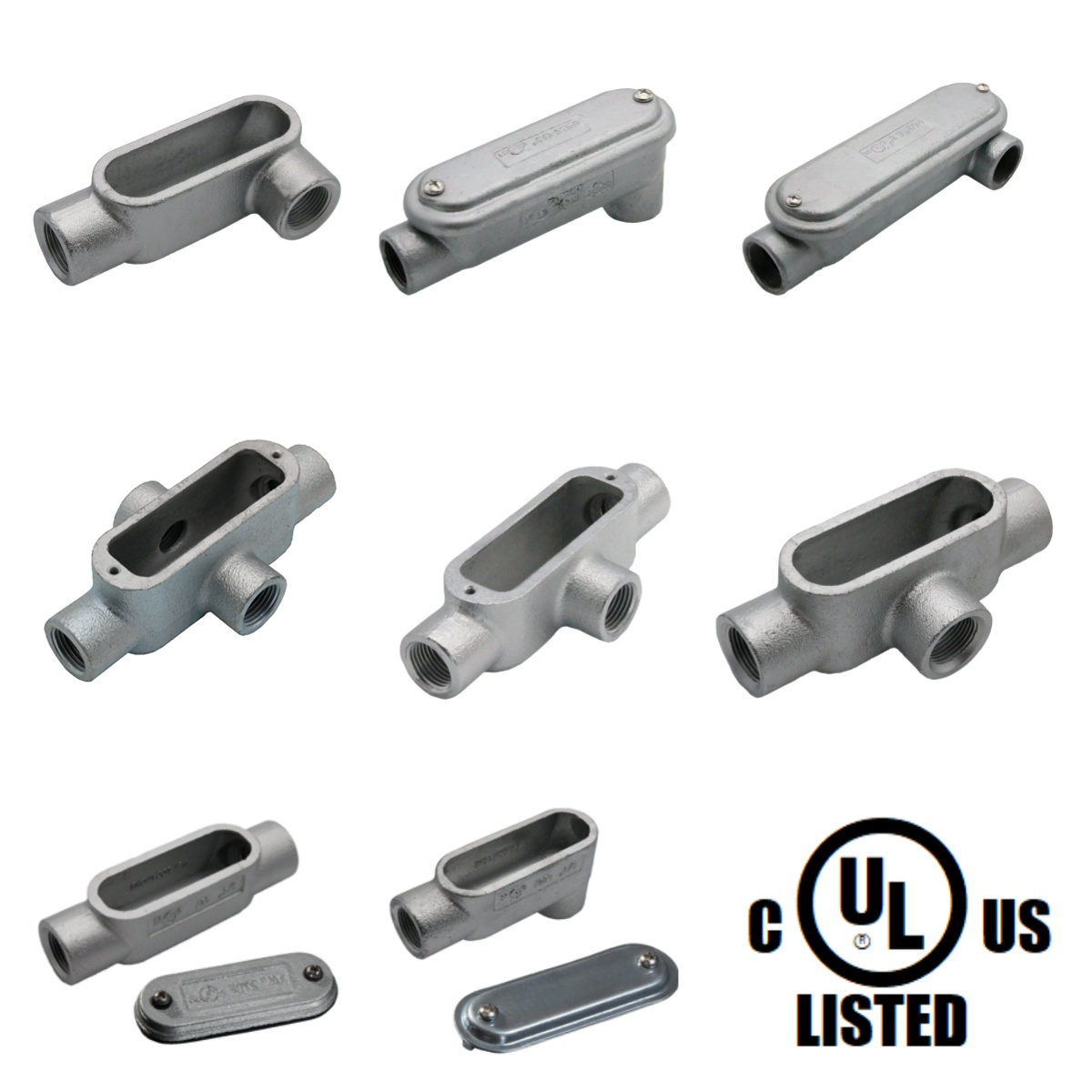
Conduit bodies are categorized by two key factors: their shape and the direction wires exit relative to their entry point. This classification is simplified using a system of letters, where the first letter indicates shape and the second (if present) denotes direction. Below are the six most common types, each tailored to specific wiring needs:
The LR (L-Shape, Right) conduit body is a two-hub fitting that forms a 90-degree angle. Wires enter through the top hub and exit through the right-side hub, making it ideal for redirecting conduits along the same plane—think turning a wire run from vertical to horizontal along a wall. Its compact design and straightforward functionality make it one of the most widely used conduit body types.
Nearly identical to the LR, the LL (L-Shape, Left) conduit body also creates a 90-degree turn but routes wires to the left instead of the right. This mirror-image design offers flexibility when working in tight spaces or when wiring needs to follow a specific leftward path. Like the LR, it’s perfect for same-plane direction changes.
The LB (L-Shape, Back) conduit body stands out for its unique access point placement—located on the back of the fitting, opposite the cover. This design makes it the go-to choice for routing wires through surfaces, such as from the exterior of a building through a wall to the interior. It maintains a 90-degree turn while allowing seamless penetration through structures, keeping wiring neat and protected.
As the name suggests, the T-Shaped conduit body features three hubs: two aligned opposite each other and one perpendicular (forming a "T"). This design enables two key functions: merging wires from two separate locations into one circuit, or splitting a single wire run into two distinct paths. It’s invaluable in scenarios like branching a main electrical line to power multiple rooms or equipment.
For more complex wiring systems, the X-Shaped conduit body offers four hubs arranged in two parallel sets (forming an "X"). This fitting acts as a central junction for four separate conduit raceways, simplifying the process of routing wires in multiple directions. It’s commonly used in industrial settings or large commercial buildings where wiring needs to branch out extensively.
Unlike the other types, the Type C conduit body doesn’t change wire direction—it connects two conduits in a straight line. Its key feature is the removable cover, which creates a serviceable access point along the raceway. This allows electricians to pull, inspect, or repair wires without cutting into the conduit itself, saving time and reducing the risk of damage.
Conduit bodies may seem like small components, but they play a critical role in ensuring electrical systems are safe, efficient, and easy to maintain. By allowing precise direction changes, circuit branching, and accessible wire management, they help electricians avoid messy, unprotected wiring runs that could lead to shorts, damage, or safety hazards.
Whether you’re a professional electrician, a DIY enthusiast, or simply curious about how electrical systems work, understanding conduit bodies is key to appreciating the thought and precision that goes into safe wiring. From simple home projects to complex industrial setups, these versatile fittings are the unsung heroes that keep our lights, appliances, and equipment powered reliably.
Next time you spot a neatly routed wire run around a corner or through a wall, chances are a conduit body is hard at work—making it all possible.